Conversational AI: Today's Practice and Tomorrow's Potential
About the workshop
In less than a decade, conversational systems have become commonplace. Every day, millions of people use natural-language interfaces such as Siri, the Google Assistant, Cortana, Alexa and others via in-home devices, phones, or messaging channels such as Messenger, Slack, Skype, among others. At the same time, interest among the research community in conversational systems has blossomed: for supervised and reinforcement learning, conversational systems often serve as both a benchmark task and an inspiration for new ML methods at conferences which don't focus on speech and language per se, such as NeurIPS, ICML, IJCAI, and others. Such movement has not been unnoticed by major publications. This year in collaboration with AAAI community, the AI magazine will have a special issue on conversational AI. Moreover, research community challenge tasks are proliferating, including the seventh Dialog Systems Technology Challenge (DSTC7), the Amazon Alexa prize, and the Conversational Intelligence Challenge live competitions at NeurIPS (2017, 2018).
Following two successful NeurIPS workshops:
2017: 9 invited talks, 26 submissions, 3 oral papers, 13 accepted papers, 37 reviewers
2018: 4 invited talks, 42 submission, 6 oral papers, 23 accepted papers, 58 reviewers,
we are excited to continue promoting cross-pollination of ideas between academic research centers and industry. The goal of this workshop is to bring together researchers and practitioners in this area, to clarify impactful research problems, understand well-founded methods, share findings from large-scale real-world deployments, and generate new ideas for future lines of research.
This workshop will include invited talks from academia and industry, contributed work, and open discussion. In these talks, senior technical leaders from many of the most popular conversational services will give insights into real usage and challenges at scale. We will end the day with an open discussion, including a panel consisting of academic and industrial researchers.
Speakers

Schedule
- Session 1 Video ↗
- 8:45-8:55OpeningVideo ↗
- 8:55-9:25Invited Talk - Alan RitterVideo ↗
- 9:25-9:40Contributed talk 1: Attention over Parameters for Dialogue SystemsVideo ↗
- 9:40-9:55Poster - Lightning round
- 9:55-10:40Coffee Break / Poster Session
- Session 2 Video ↗
- 10:40-11:10Invited Talk - Ryuchiro HigashinakaVideo ↗
- 11:10-11:25Contributed talk 2: Persona-aware Dialogue Generation with Enriched Profile
- 11:25-11:40Contributed talk 3: HSCJN: A Holistic Semantic Constraint Joint Network for Diverse Response GenerationVideo ↗
- 11:40-11:55Contributed talk 4: Hierarchical Reinforcement Learning for Open-Domain DialogVideo ↗
- 11:55-1:45Lunch Break
- Session 3 Video ↗
- 1:45-2:15Invited Talk - David Traum
- 2:15-2:45Invited Talk - Y-Lan BoureauVideo ↗
- 2:45-3:00Contributed talk 5: Domain Transfer in Dialogue Systems without Turn-Level SupervisionVideo ↗
- 3:00-3:15Contributed talk 6: Reinforcement Learning of Multi-Domain Dialog Policies Via Action EmbeddingsVideo ↗
- 3:15-3:30Contributed talk 7: Bayes-Adaptive Monte-Carlo Planning and Learning for Goal-Oriented DialoguesVideo ↗
- 3:30-4:15Coffee Break / Poster Session
- Session 4 Video ↗
- 4:15-4:45Invited Talk - Gabriel SkantzeVideo ↗
- 4:45-5:00Contributed talk 8: Recurrent Chunking Mechanisms for Conversational Machine Reading ComprehensionVideo ↗
- 5:00-5:50Panel / Open Discussion - All invited speakers (submit questions here )
- 5:50-6:00Closing Remarks
Accepted papers
- Bayes-Adaptive Monte-Carlo Planning and Learning for Goal-Oriented DialoguesJang, Youngsoo; Lee, Jongmin; Kim, Kee-Eung
- Domain Transfer in Dialogue Systems without Turn-Level SupervisionBingel, Joachim; Petrén Bach Hansen, Victor; Gonzalez, Ana V; Budzianowski, Paweł; Augenstein, Isabelle; Søgaard, Anders
- Persona-aware Dialogue Generation with Enriched ProfileZheng, Yinhe; Chen, Guanyi; Huang, Minlie; Liu, Song; Zhu, Xuan
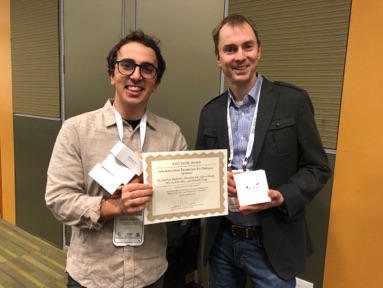
- Attention over Parameters for Dialogue SystemsBest paperMadotto, Andrea; Lin, Zhaojiang; Wu, Chien-Sheng; Shin, Jamin; Fung, Pascale
- Hierarchical Reinforcement Learning for Open-Domain DialogSaleh, Abdelrhman; Jaques, Natasha; Ghandeharioun, Asma; Shen, Judy Hanwen; Picard, Rosalind
- Recurrent Chunking Mechanisms for Conversational Machine Reading ComprehensionGong, Hongyu; Shen, Yelong; Yu, Dian; Chen, Jianshu; Yu, Dong
- HSCJN: A Holistic Semantic Constraint Joint Network for Diverse Response GenerationWang, Yiru; Si, Pengda; Lei, Zeyang; Xun, Guangxu; Yang, Yujiu
- Reinforcement Learning of Multi-Domain Dialog Policies Via Action EmbeddingsMendez, Jorge A; Geramifard, Alborz; Ghavamzadeh, Mohammad; Liu, Bing
- Multi-Turn Beam Search for Neural Dialogue ModelingKulikov, Ilia; Lee, Jason; Cho, Kyunghyun
- Just Ask:An Interactive Learning Framework for Vision and Language NavigationChi, Ta-Chung; Shen, Minmin; Eric, Mihail; Kim, Seokhwan; Hakkani-tur, Dilek
- Improving Robustness of Task Oriented Dialog SystemsEinolghozati, Arash; Gupta, Sonal; Mohit, Mrinal; Shah, Rushin
- Hierarchical Tensor Fusion Network for Deception Handling Negotiation Dialog ModelNguyen, The Tung; Yoshino, Koichiro; Sakti, Sakriani; Nakaura, Satoshi
- Conversational QA for FAQsCampos, Jon Ander; Agirre, Eneko; Soroa, Aitor; Otegi, Arantxa; Deriu, Jan; Cieliebak, Mark
- Dialogue Model and Response Generation for Emotion Improvement ElicitationLubis, Nurul; Sakti, Sakriani; Yoshino, Koichiro; Nakaura, Satoshi
- ACUTE-EVAL: Improved dialogue evaluation with optimized questions and multi-turn comparisonsLi, Margaret; Weston, Jason; Roller, Stephen;
- MA-DST: Multi-Attention-Based Scalable Dialog State TrackingKumar, Adarsh; Ku, Peter; Goyal, Anuj Kumar; Metallinou, Angeliki; Hakkani-tur, Dilek
- Aging Memories Generate More Fluent Dialogue Responses with Memory Augmented Neural NetworksFlorez, Omar U; Muller, Erik
- Learning to Control Latent Representations \or Few-Shot Learning of Named EntitiesFlorez, Omar U; Muller, Erik
- Neural Assistant: Joint Action Prediction, Response Generation, and Latent Knowledge ReasoningNeelakantan, Arvind; Narang, Sharan; Yavuz, Semih
- Retrieval-based Goal-Oriented Dialogue GenerationGonzalez, Ana V; Augenstein, Isabelle; Søgaard, Anders
- Investigation of Error Simulation Techniques for Learning Dialog Policies for Conversational Error RecoveryFazel-Zarandi, Maryam; Wang, Longshaokan; Tiwari, Aditya; Matsoukas, Spyros
- Way Off-Policy Batch Deep Reinforcement Learning of Implicit Human Preferences in DialogJaques, Natasha; Ghandeharioun, Asma; Shen, Judy Hanwen; Ferguson, Craig; Lapedriza Garcia, Agata; Jones, Noah; Gu, Shixiang; Picard, Rosalind
- Incorporating rules into end-to-end dialog systemsRazumovskaia, Evgeniia; Eskenazi, Maxine
- Learning Conversational Web InterfacesGur, Izzeddin; Yan, Xifeng
- Towards Personalized Dialog Policies for Conversational Skill DiscoveryFazel-Zarandi, Maryam; Biswas, Sampat; Summers, Ryan; Elmalt, Ahmed; McCraw, Andy; McPhilips, Michael; Peach, John
- The Eighth Dialog System Technology ChallengeKim, Seokhwan; Galley, Michel; Gunasekara, Chulaka; Lee, Sungjin; Atkinson, Adam; Peng, Baolin; Schulz, Hannes; Gao, Jianfeng; Li, Jinchao; Adada, Mahmoud; Huang, Minlie; Lastras, Luis A.; Kummerfeld, Jonathan K; Lasecki, Walter; Hori, Chiori; Cherian, Anoop; Marks, Tim K; Rastogi, Abhinav; Zang, Xiaoxue; Sunkara, Srinivas; Gupta, Raghav
- Multi-domain Conversation Quality Evaluaiton via User Satisfaction EstimationBodigutla, Praveen Kumar; Matsoukas, Spyros; Polymenakos, Lazaros
- Paper details to be posted at a later date, at author’s request<Authors>
- TAM: Using trainable-action-mask to improve sample-efficiency in reinforcement learning for dialogue systemsWu, Yen-Chen
- Domain-Specific Question Answering at Scale for Conversational SystemsSemnani, Sina; Pandey, Madhulima ; Pandey, Manish
Call for papers
We invite you to submit your novel contributions (submission page) in the area of conversational AI in NeurIPS style with maximum of 8 pages excluding the references. You can add supplementary material in addition to 8 pages, but reviewers are not required to review the extra material (e.g. your paper should stand on its own without the supplementary material). Selected papers will be presented through invited talks or posters. Maximum allowed size of posters is 36 x 48 inch (91 x 122 cm). Posters should be on light weight paper and not laminated . Submitting papers that are under review by other venues are ok. However, please avoid submitting already peer-reviewed and published work. Notice that our workshop is not archival. However, accepted submission will be hosted on this website similar to last year’s workshop. Given authors concern around posting their submissions to arXiv the organizing committed decided to lift the anonymity requirement for our workshop. This means the anonymity will be optional and decided by the authors. Hence, you can post your submissions to arXiv. For further questions, feel free to reach out to co-chairs through email (alborz dot geramifard at gmail dot com; jdw at alumni dot princeton dot edu).
This year, we will have two submission phases due to limitation for allocating tickets to authors. We advise all workshop attendees to enter their names for the NeurIPS lottery here.
Phase 1 (Early Submission) : Please follow the early submission, only if you did not win a ticket in the NeurIPS lottery. We will notify accepted authors by October 1st and provide tickets to the author presenting the paper.
Phase 2 (Regular Submission) : If you already acquired the NeurIPS ticket, please follow the regular submission process below.
Organizers









Program committee
Photos